When Video Becomes Searchable: The New Era of AI Video Intelligence
Key Takeaways:
.png)
A recent Financial Times piece captured a major shift in the world of video intelligence.
For decades, security cameras were mostly treated as recording devices. They captured what happened, but the footage itself remained passive: stored, reviewed, and only useful if someone had the time to manually search through it.
Then came the first wave of video analytics.
These systems helped teams detect predefined objects and attributes: faces, license plates, weapons, motion, vehicle types, clothing colors.
Useful, but limited.
Real-world security is rarely that clean.
Teams are not always looking for “a person” or “a car.”
They are looking for behavior.
A vehicle that circles the same block several times.
A person who leaves a bag and walks away.
Someone moving between restricted areas after hours.
Two people exchanging something near an entrance.
These are not simple detection problems.
They are search problems.
They are context problems.
They are behavior problems.
From predefined parameters to open-ended questions
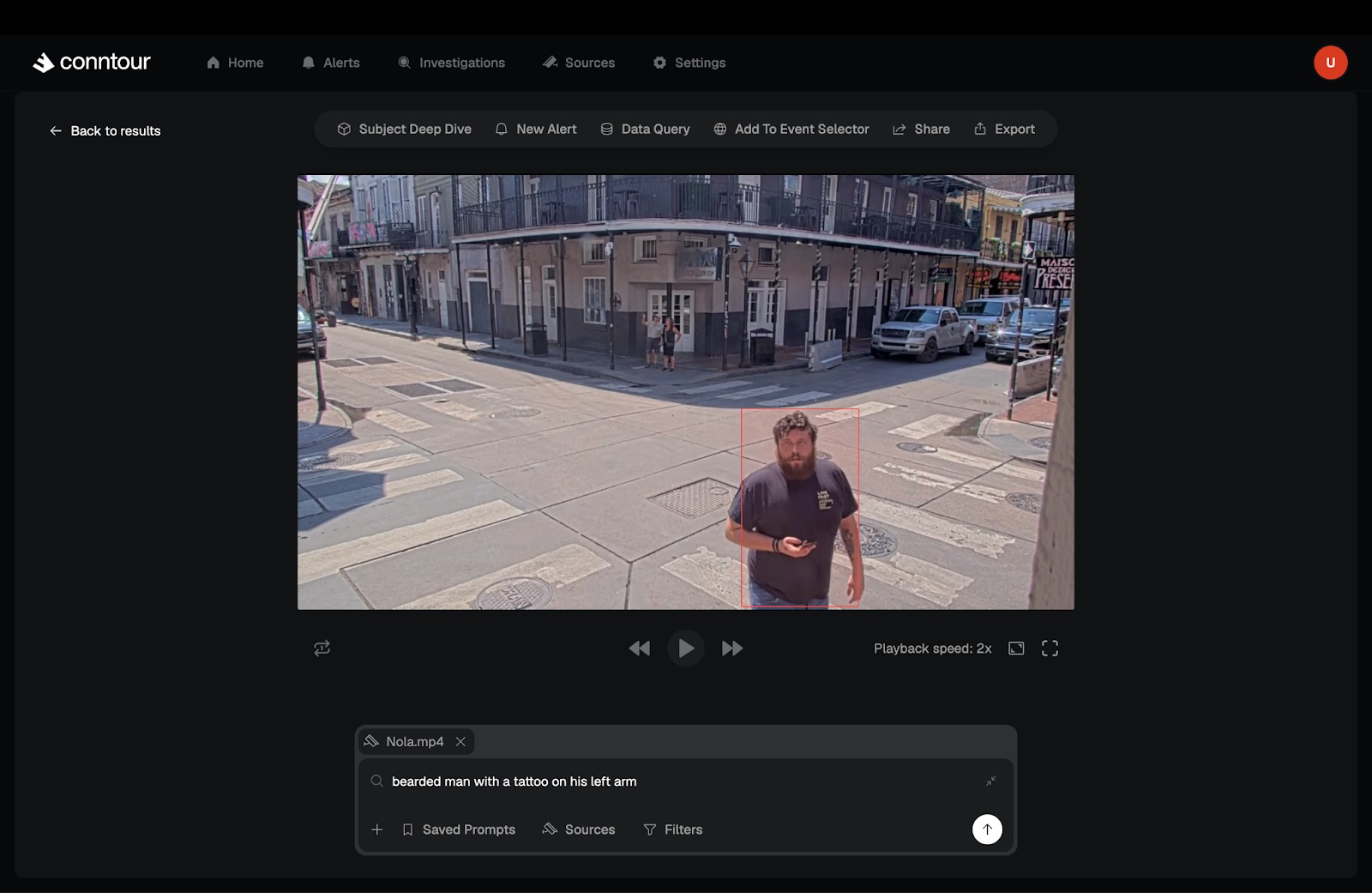
The Financial Times described the new capability as enabling “an almost unlimited range of enquiries” through language-based video search.
That is the shift.
Older video analytics systems were built around predefined parameters: faces, plates, objects, colors, motion, and other fixed categories.
The next generation is built around scale, language, and intent.
It is not about checking whether a predefined object appears in one frame.
It is about asking open-ended questions across thousands of hours, thousands of feeds, and real-world behavior.
What is the operator trying to find?
What pattern is starting to form?
What moment matters now?
That is the shift from detection to intelligence.
This matters because real incidents do not arrive as clean data.
They arrive as fragments:
a vague description,
a partial tip,
an unclear timeline,
a camera no one thought to check.
Security teams do not have the luxury of perfect inputs.
They need tools that work the way real investigations work: messy, fast, and full of unknowns.
The technology should understand the way people naturally describe what they are looking for.
Video is becoming something teams can ask questions
In the article, Conntour CEO Matan Goldner explained the shift simply:
“We can communicate using language with computers about what they see.”
That sentence captures what is changing.
Video is no longer something teams only watch.
It is something they can query.
The new layer above existing cameras
The world is becoming more tense, more fragmented, and more unpredictable. Security teams are being asked to respond faster, across more cameras, more locations, and more information than ever before.
Most of them do not need more cameras.
They already have cameras.
They already have video management systems.
They already have more footage than any team can realistically watch.
The missing layer is intelligence.
A layer that connects to existing camera networks.
Searches across video using natural language.
Triggers alerts based on behavior.
Helps teams move from footage to answers in seconds.
Because the next generation of security will not be defined by who records the most footage.
It will be defined by who can understand it fast enough to act.


%20(1).png)

.jpg)
Stay Updated
Get the latest insights on AI surveillance and
security intelligence.