A Primer on Conntour
Key Takeaways:
During my time at the IDF, I led video surveillance. We had a very large number of cameras at our disposal and thus we had all the footage we needed. However, we had one major problem. We didn’t have enough human operators to analyze these cameras. Even if our cameras captured every square foot on our areas of interest, how could we possibly make use of that footage with such a limited number of eyeballs?
That’s how the idea for Conntour was born. Security teams, whether in intelligence units, police departments, or private companies, are drowning in footage they can’t possibly parse. Cameras alone don’t protect anyone. What protects people is being able to see and interpret what those cameras are capturing. And today, that gap is massive.
Monitoring hundreds or thousands of cameras is impossible. That means security teams regularly miss critical events and investigations take days or weeks of manual footage review.
There are dozens of video analytics in the market that try to solve this problem. They do this by detecting specific parameters, such as weapons, bags, clothing color, or license plate. However, the number of parameters (filters) they offer is finite. The best of these vendors offer up to 30, which is not enough to detect the infinite scenarios that can present in the day-to-day.
Think about this. None of the existing legacy tools can help you find complex things in video, like:
- A man handing a bag to another person
- A person wearing a blue and white striped shirt
- A UPS truck
Legacy tools don’t understand context, they only work with simple rules. As a result, they’re extremely limited in the kinds of situations they can detect or flag.
Humans can’t watch all your cameras, and existing CCTV analytics are only a small improvement. They don’t solve the real problem. Security teams need something completely different.
Meet Conntour
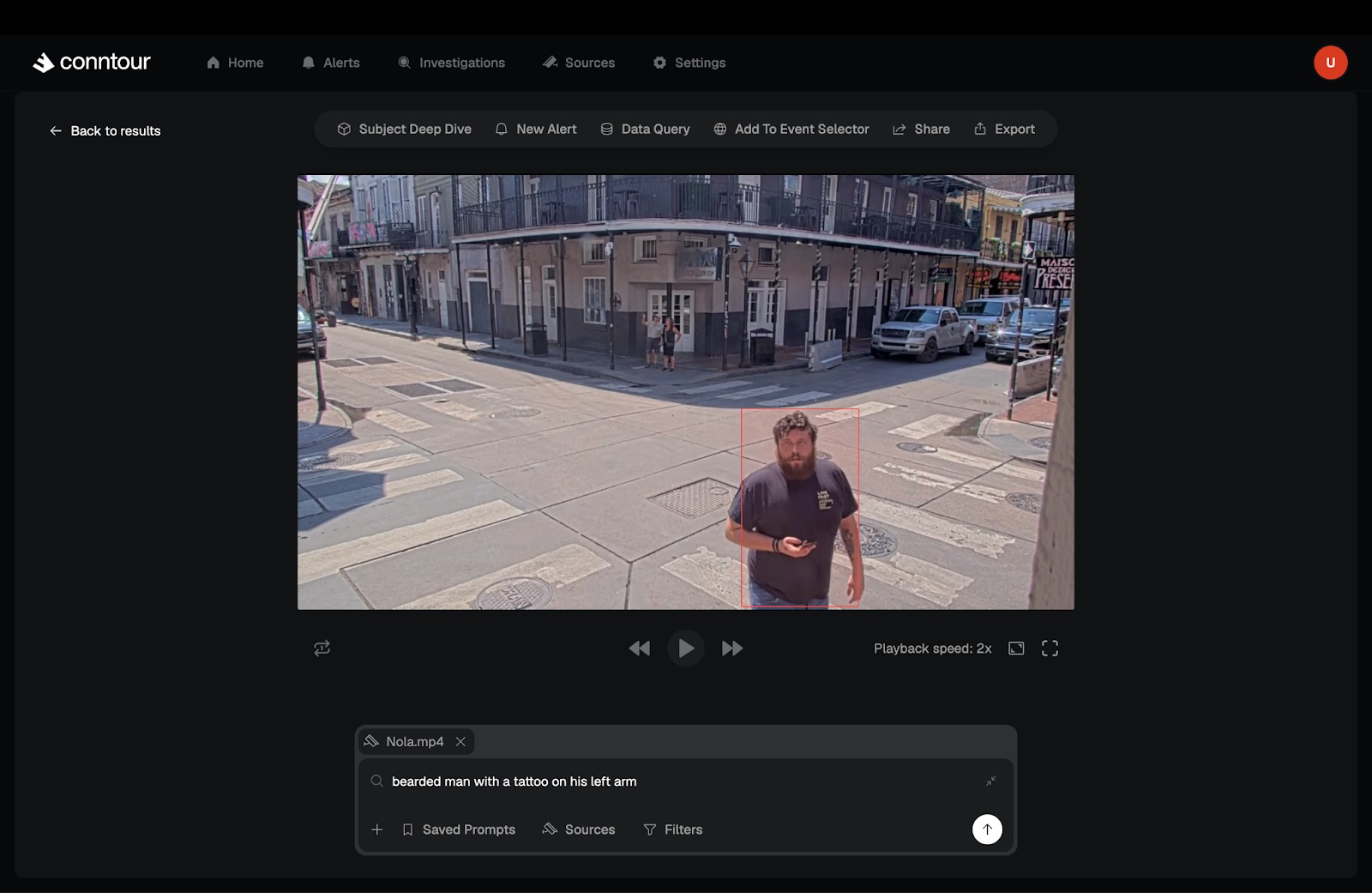
Conntour lets intelligence and homeland-security agencies talk with their CCTV footage in English. Users can search past footage (“Find a man with tattoos on his left arm”), configure real-time alerts (“Notify me if someone climbs over the wall”), and extract data (“How many pickup trucks entered yesterday?”).
You’re not limited to a fixed set of rules or filters. Whatever you can describe in words, Conntour can find.
Let’s go over some examples which will help you understand the capabilities of our system.
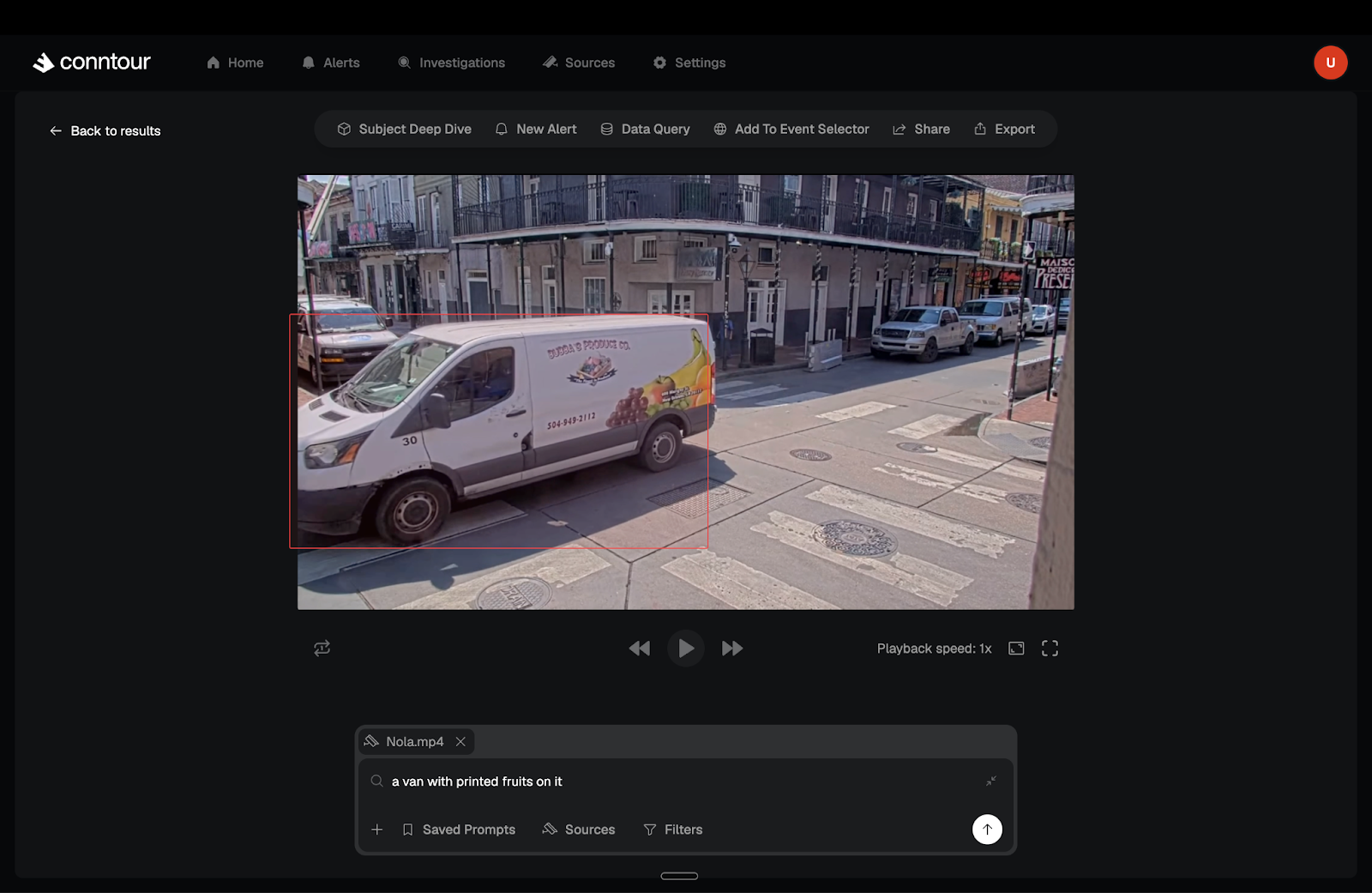
You get a tip that a terrorist is on the move. All you know is he’s traveling in a van with printed fruits on it. You don’t know the license plate. You don’t know the destination. You don’t know how much time you have.
With existing security tools, you’re left with two options. Neither works.
- Traditional video analytics. These systems depend on fixed parameters—license plates, vehicle color, make, or model. But there is no parameter for “a van with fruits printed on the side.” If you can’t express what you’re looking for in the system’s predefined terms, the system is useless.
- Human monitoring. You task security operators with watching thousands of camera feeds, hoping someone spots the van as it passes by. Even with a highly trained team, this is very complex. The footage volume is massive, and the odds of finding the right vehicle in time are low.
Now imagine you have Conntour.
You simply describe what you’re looking for in English. You prompt your camera network with: “a van with a print of fruits on it”. Within 5 seconds, Conntour scans all available footage and shows you exactly where that van was spotted. Furthermore, you can set real-time alerts. Every new sighting automatically sends you a notification as the vehicle continues moving.
Now let’s look at a different example.
You are in charge of protecting a critical facility, such as an army base or an intelligence HQ. Your goal is to detect suspicious behavior around the site, including:
• Someone taking photos of the facility
• Someone leaving a bag unattended
• Someone attempting to climb a fence
• Someone circling the entrance multiple times within a short period
With existing tools, detecting this kind of behavior is extremely difficult. Traditional video analytics are built around simple attributes, not actions or intent. There is no reliable way to define behaviours such as “taking photos” or “acting suspicious” using fixed parameters.
Human operators can sometimes notice these behaviors, but coverage is inconsistent. Not every camera is monitored at all times. Even when they are, these events often happen in just a few seconds, which makes them easy to miss.
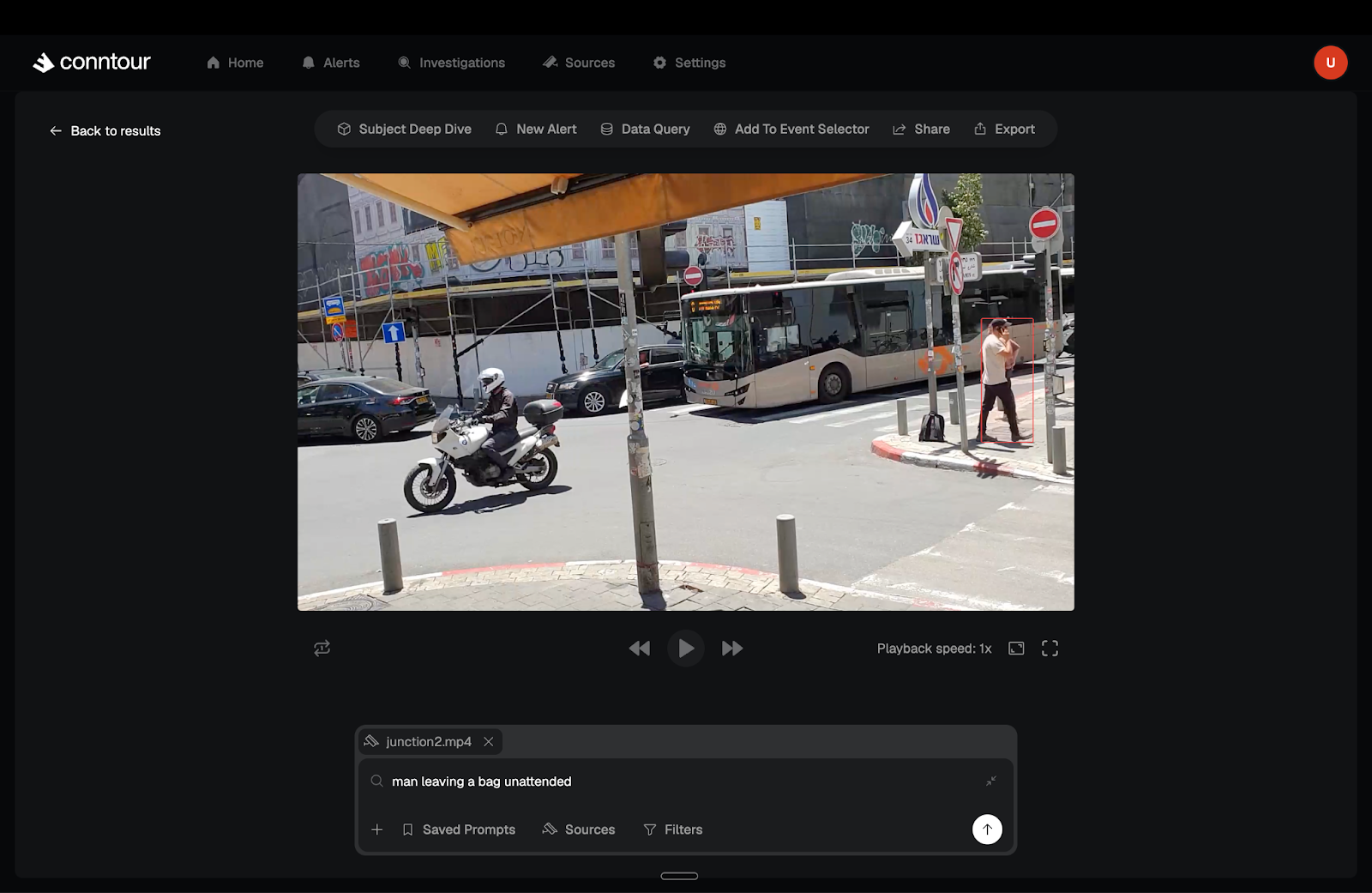
This is the type of problem Conntour is designed to solve. In the example below, a man places a bag on the ground and then walks away. Conntour detects this sequence of actions and triggers an alert in real time, allowing a human operator to intervene in a matter of seconds.
Conntour can run fully on premises without risking the safety or confidentiality of the footage. Every frame of video stays inside the organization’s own facilities, under its own security controls. No footage is uploaded to the cloud, and no external servers ever touch the video stream.
Lastly, an important feature: Conntour works with the cameras your organization already has. There’s no need for new hardware or any complex physical installation. The system is deployed on top of the existing setup, connects to your video management system, and starts analyzing footage immediately. It simply adds an intelligence layer over the cameras you already have.
About Conntour - Conntour is the most advanced video analytics tool for security teams, built by computer vision experts from top Israeli intelligence units, including Unit 8200 and Mossad. Our system is already in use worldwide across leading national security agencies, police departments, and enterprise organizations.

.png)

%20(1).png)

.jpg)
Stay Updated
Get the latest insights on AI surveillance and
security intelligence.