Public Safety & Law Enforcement Tech: Startups to Watch
Key Takeaways:
01
Public safety technology is evolving rapidly, with law enforcement startups raising over $1 billion in early 2025 alone.
02
Investigators can now use plain English to search thousands of hours of CCTV footage and case files, solving in seconds what used to take weeks.
03
New AI tools are taking over the heavy lifting, automating time-consuming tasks so officers and investigators can focus on what matters most.

Public safety technology is changing faster than it has in decades. According to The Wall Street Journal, law enforcement startups raised $1 billion in the first seven months of 2025. That is more than double the total amount raised in all of 2024.
As more startups enter the public safety space, new tools are appearing that would have sounded like science fiction just a few years ago.
- Investigators can now search thousands of hours of CCTV footage by typing something like, “show me a bald man with a green backpack.”
- Body-camera footage can be turned into a complete police report in minutes, without the officer writing a single word.
- AI-powered cameras are detecting traffic violations, such as failing to yield at a stop sign.
- AI systems can now review thousands of hours of recorded calls and surface the few conversations a detective would have spent days trying to find.
Below are some of the most remarkable innovative companies building in the law enforcement space as of 2026.
- Conntour
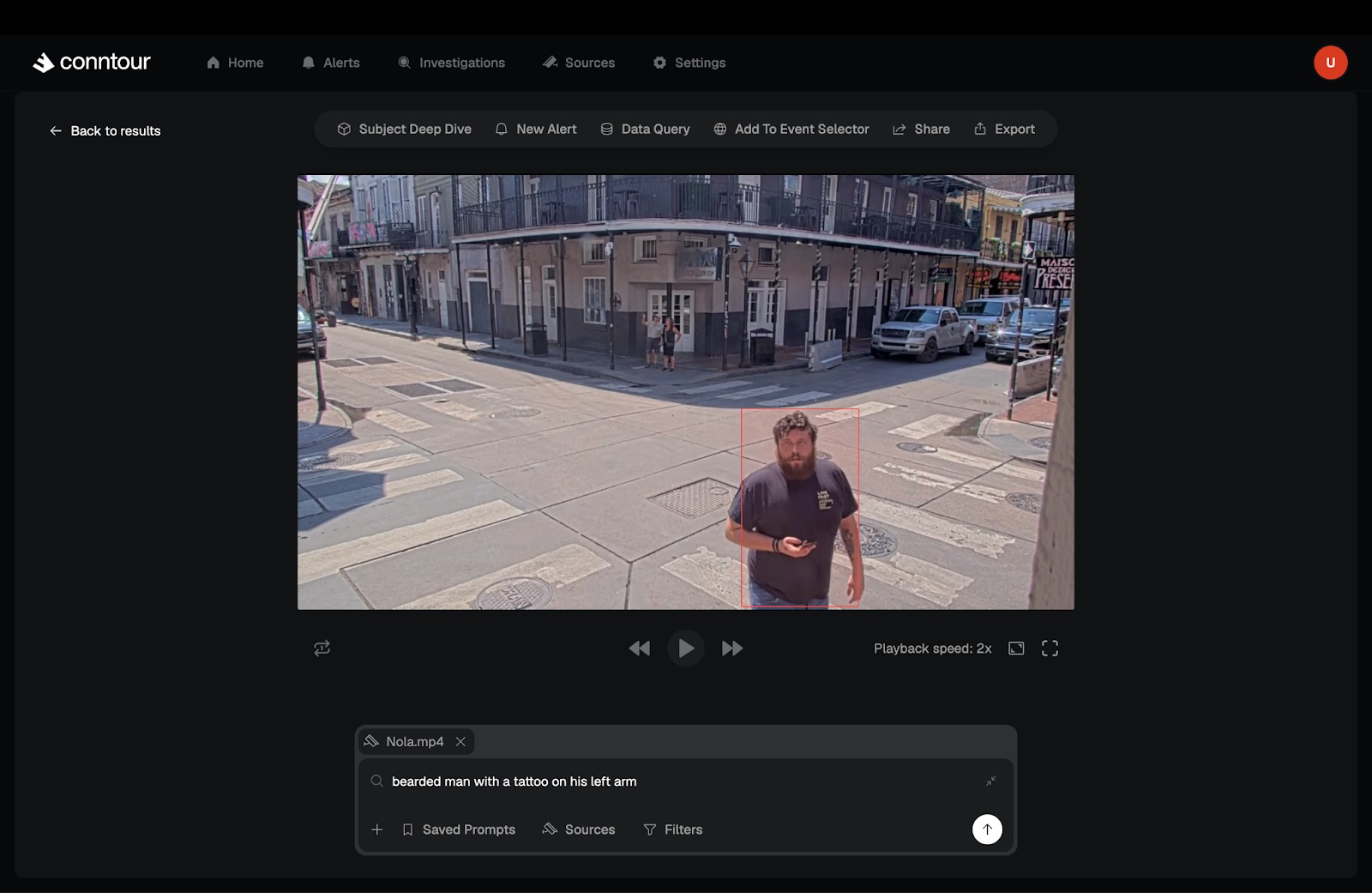
- Conntour enables intelligence and homeland-security agencies to query their CCTV footage using natural language. Users can search past footage (“Find a woman wearing a blue Nike jacket”), configure real-time alerts (“Notify me if someone climbs over the wall”), and extract data (“How many pickup trucks entered yesterday?”).
- Unlike traditional video analytics that rely on rigid filters (for example weapon, bag, license plate), Conntour allows unlimited specific scenarios to be described in plain language. No pre-defined parameters, just ask anything with full flexibility.
- Obvio
- Obvio is building solar-powered AI cameras to detect unsafe driving behavior
- The cameras watch stop signs, crosswalks, and school zones and automatically detect dangerous driving behaviors, including distracted driving, failure to stop, and near-misses—things traditional tools like radar or breathalyzers can’t capture. Because the hardware is solar-powered, cities can install it in just a couple of days, and agencies can use it for public education, directed enforcement for officers, or fully automated enforcement programs.
- Abel
- Abel is a system that turns body-camera footage directly into police reports. Instead of producing a transcript, its main product, Abel Writer, generates both the narrative and the structured fields officers are required to fill out.
- This matters because paperwork consumes a large share of an officer’s time. In many departments, report writing takes up a third or more of a shift. By pulling details directly from video, Abel captures information officers may miss in fast-moving or chaotic situations and produces complete reports without manual writing.
- Codefour
- CodeFour is a system that reviews body-cam and security-cam footage and pulls out the moments that matter. It identifies who spoke, what was said, when key events happened, and which objects or locations appear. It works with the systems departments already use, including Axon, Evidence.com, Spillman, and Panasonic. Officers can ask plain-English questions like “Did I read Miranda?” or “Where did the suspect admit the offense?” without manually scrubbing through hours of video.
- Hyper
- Hyper builds a system that answers non-emergency emergency calls so human operators do not have to pick up every phone call.
- When someone calls, the system answers, listens to what the caller needs, and follows the same procedures a call taker would. It can handle routine requests on its own, ask follow-up questions, and pass the call to a human when the situation is complex or urgent. The goal is to reduce wait times and free up trained operators to focus on real emergencies.
- Closure
- Closure is a system that helps investigators work through large volumes of digital evidence. It brings videos, phone extractions, documents, and reports into one place and makes them searchable. Instead of digging through files manually, investigators can ask plain-English questions and get answers that point back to the original evidence.
- The system is built so its results can be trusted. Every answer is traceable to the underlying material, so investigators can see where conclusions come from and verify them.
- Longeye
- Longeye is a system designed to help investigators work through large and time-consuming case material. It handles things like thousands of recorded phone calls, large case files, and massive evidence dumps that would normally take weeks to review. Instead of listening to every call or reading every page, investigators can focus on the parts that matter.
- The system analyzes the material and ranks what is most relevant to the case. In tests on closed cases, Longeye identified the same critical information detectives had previously found, but in hours rather than weeks.
- RapidSOS
- RapidSOS is a system that connects emergency data directly to 911 and first responders. It links information from phones, vehicles, buildings, and sensors to local emergency agencies as soon as something goes wrong. Instead of relying on someone to place a call and explain what is happening, the system sends digital information straight to the people who need it.
- Many modern devices can already detect emergencies, such as car crashes, falls, fires, or health events. RapidSOS takes that data and delivers it to the correct responders, including the person’s location and details about the incident. This allows emergency teams to know who needs help, where they are, and what is happening, even when no one is able to make a call.
- Carbyne
- Carbyne is a cloud-based system that helps emergency centers handle calls with more context. When someone contacts emergency services, the platform pulls in data that already exists on the caller’s device, such as location, live video, and language information. That data is shared in real time with call takers, dispatchers, and responders so everyone sees the same picture of what is happening.
- The system also helps centers manage high call volumes. It can triage incoming calls, group multiple calls about the same incident, and handle non-emergency questions without human involvement. It supports real-time transcription and translation across many languages, allowing call takers and callers to communicate even when they do not share a language.
- Sworn AI
- Sworn AI is a system focused on health and wellness for public safety officers. It combines data from three sources: call activity, biometric signals from wearables officers already use, and a short daily check-in. By looking at these inputs together, the system identifies patterns related to stress, fatigue, and recovery and gives officers practical guidance on sleep, fitness, nutrition, and stress management.
- For agencies, the system provides aggregated wellness insights rather than individual health data. Departments can see trends across teams, such as changes in readiness or rising stress levels, without accessing personal biometric details. This helps agencies design better support programs and address burnout before it leads to attrition.
- CAT Labs
- Cat Labs builds a system that helps investigators find cryptocurrency hidden inside large collections of digital evidence. Modern cases produce massive amounts of data across phones, laptops, cloud accounts, and emails. Investigators often do not know what crypto-related artifacts look like or where to find them.
- The system scans seized data automatically and flags items like wallet screenshots, seed phrases, private keys, and other clues. This allows investigators to focus on the right evidence instead of manually searching through thousands of files.

.png)

%20(1).png)
.jpg)
Stay Updated
Get the latest insights on AI surveillance and
security intelligence.
Thank you! Your submission has been received!
Oops! Something went wrong while submitting the form.